


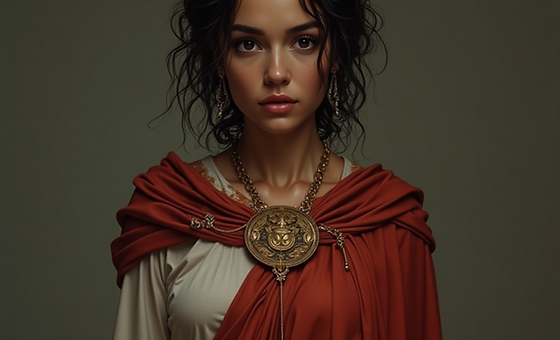
Princess or Queen???
- Loremaster

- Mar 30
- 4 min read
The candlelight trembled as though it feared her.
Not a soul in the great hall of London’s western quarter would have named the reason aloud—but all felt it. The air itself bent around her presence, as if memory and desire had been shaped into flesh and given command to walk.
She was called now Vavasseur Isabelle Lamar, and in the year 1068, there were few in Albion—Kindred or mortal—who did not know the weight of that name.
But once… long before London, before Normandy, before the long shadow of Mithras stretched across these lands… she had been Ilsanna, daughter of Chlodio, chieftain of the Franks.
Gaul, in the Dying Days of Rome
Ilsanna had been born into a world between worlds.
Rome still claimed dominion, its banners flying over cities of stone and order, yet the forests whispered older truths. Her father, Chlodio, was no Roman lord—he was a king of the wild edges, where iron met oak and blood sealed loyalty.
She learned early that beauty was not softness.
Her mother taught her the songs of their people—chants that stirred hearts and bound warriors. Her father taught her how men broke, how alliances were forged not just with steel, but with gaze, word, and silence.
Ilsanna watched Roman governors bow to her father in public… and curse him in private.
She learned both languages.
And she learned which one mattered more.
The Embrace
It was not war that claimed her.
It was admiration.
A traveling noblewoman—pale, exquisite, and utterly out of place among the mud and fire of the Frankish court—arrived under the pretense of diplomacy. She spoke with Ilsanna for hours, days… studying her, as one studies a rare and dangerous jewel.
“You understand power,” the woman had said, brushing a lock of Ilsanna’s hair aside.
“Not as men do. You understand how it breathes.”
Ilsanna smiled.
“And you do not breathe at all.”
The woman laughed.
That night, beneath a sky untouched by Roman roads or Frankish ambition, Ilsanna died.
And Isabelle Lamar was born.
The Long Becoming
Centuries shaped her—but never dulled her.
She walked the courts of Merovingian kings, whispered into the ears of bishops, guided marriages that shifted borders without a single sword drawn. She became what the Clan Toreador prized most: not merely beauty, but influence refined into art.
Men died for her approval.
Kings rewrote laws at her suggestion.
And Kindred… learned to listen.
She took the name Isabelle Lamar when France itself began to take shape, and from that point onward, she ceased to follow history.
She began to write it.
The Norman Tide
When William the Conqueror turned his gaze toward England, Isabelle did not hesitate.
Where others saw conquest, she saw opportunity.
The Kindred of Europe were fractured—ambitious, proud, and desperate for territory. The crossing into Albion was not merely a war of mortals; it was a migration of predators.
And predators required order.
She ensured it.
She gathered the Toreador, yes—but also the Ventrue, the Lasombra exiles, the wandering ancillae seeking favor. She did not command them outright. That would have been crude.
Instead, she made it… unthinkable not to follow her lead.
They called her Vavasseur, a title of landholding and fealty among mortals—but among Kindred, it meant something more.
It meant she was the axis upon which their ambitions turned.
Albion, 1068 AD
Now she stood in London—still raw from conquest, still bristling with Saxon resentment and Norman pride.
The hall around her was filled with Kindred newly arrived: sharp-eyed, hungry, uncertain.
They watched her.
They always did.
“England,” she said softly, her voice carrying without effort, “is not Gaul. It is not Normandy. It is not yours… yet.”
A murmur stirred, quickly silenced.
She stepped forward, the firelight catching her features—timeless, flawless, and utterly unreadable.
“You have followed a king across the sea,” she continued. “But kings rule men. We rule what men become.”
A Ventrue knight shifted uncomfortably. A Lasombra priest narrowed his eyes. A Brujah leaned forward, intrigued.
“And here,” Isabelle said, “you will not fracture yourselves into petty courts and fleeting dominions. Not while I stand among you.”
There was no threat in her tone.
None was needed.
The Shadow of Mithras
There was, however… a shadow.
The ancient power of Mithras still lingered over Albion, even in absence. His childer—his legacy—clung to the land like roots beneath stone.
Isabelle did not fear him.
But she did not ignore him.
Her conflict with Mithras was not open war. It was something far more dangerous: a quiet contest of influence.
And for now, she held the advantage.
So long as Julius, that distant echo of Mithras’ blood, remained far from London… Isabelle Lamar was unchallenged.
A Queen Without a Crown
Later that evening, as the hall emptied and whispers replaced proclamations, a young Kindred approached her.
“My lady,” he said, bowing low. “What would you have us build here?”
Isabelle turned her gaze upon him, and for a moment, he forgot what century he lived in.
“Not a kingdom,” she said.
“Those crumble.”
She stepped past him, her presence trailing like the memory of a dream.
“We will build something far more enduring.”
She paused at the threshold, glancing back just once.
“A society,” Isabelle Lamar said, “that cannot imagine itself without me.”
And as she vanished into the London night, every Kindred present understood a single, unspoken truth:
William may have conquered England.
But Isabelle Lamar…
had claimed its soul.


Comments